

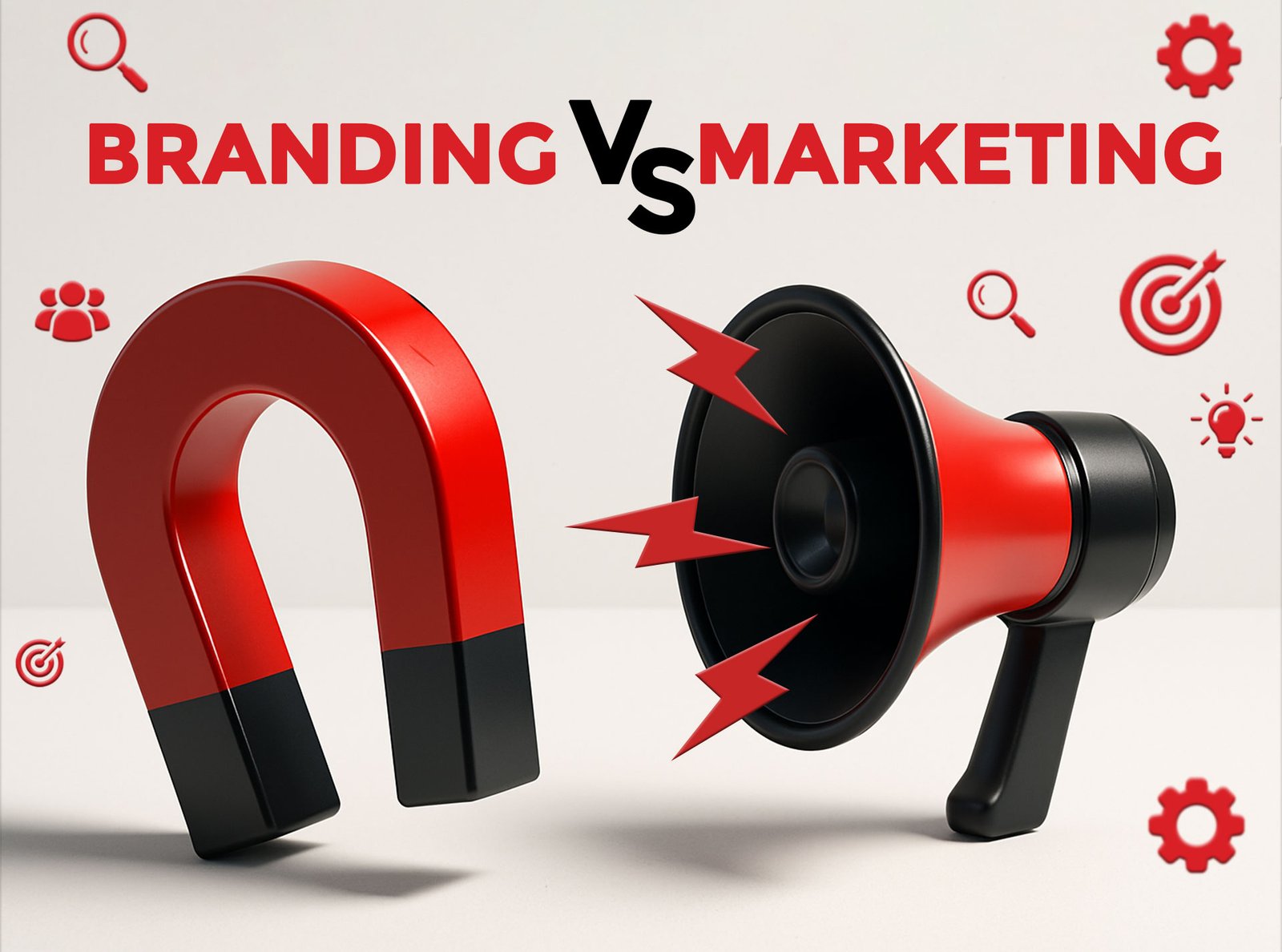
In the business world, people often mix up the terms branding and marketing, assuming both mean the same thing. But when you look at how companies grow, scale, and build trust, these two functions perform very different roles. One creates your identity; the other amplifies it. One builds trust; the other brings revenue. One sets the foundation; the other accelerates growth.
To write this guide, Brand Buggzzz analysed the performance of over 120+ small, mid-size and enterprise brands between 2020–2024, studied major industry reports from branding consultancies, and reviewed marketing performance case studies from global markets. The insights clearly show that businesses that treat branding and marketing as two separate, but connected pillars outperform competitors by a huge margin.
What Branding Really Means?
Branding is not the colour of your logo, the curve in your typography, or the aesthetic of your packaging. Branding is the meaning attached to your business. It is the emotional response people feel even before they purchase something from you. Every interaction, design element, tone, and promise contributes to shaping that meaning.
When Brand Buggzzz audited 53 SMEs in India across different sectors—FMCG, healthcare, real estate, ed-tech—we found that 72% did not have a defined brand voice, and 61% used inconsistent visual styles across social media, website, and print materials. This inconsistency not only weakens user recall but also makes marketing less efficient because every campaign has a different identity.
What Branding Controls
Branding dictates the long-term perception of your business. It influences:
- How customers emotionally connect with your brand
- Whether they trust your business
- What reputation you hold in the market
- How premium your products or services appear
- Your pricing power
For example, in a Brand Buggzzz study comparing two cafés in Pune with similar pricing, the café with consistent branding (fixed colour palette, uniform packaging, and a defined tone) was able to charge 18–22% more because customers perceived them as “premium,” despite both having similar product quality.
Branding builds trust before marketing even begins.
What Marketing Really Means?
Marketing is every activity you do to increase your visibility, generate interest, and bring customers to your business. It is action-driven, performance-tracked, and number-focused.
Branding shapes meaning.
Marketing shapes demand.
Marketing evolves faster than branding because the platforms, consumer behavior, and technology change constantly. What worked two years ago may not work today, but branding remains consistent, giving stability to your campaigns.
During Brand Buggzzz’ performance study for 24 brands running Google Ads and social media campaigns, companies with a strong brand identity saw a 27% lower Cost Per Lead (CPL) on average because people trusted their ads more.
Branding vs Marketing: The Actual, Research-Backed Difference
Here is a research-backed comparison based on studies from WARC, HubSpot, McKinsey, and internal audits by Brand Buggzzz:
| Aspect | Branding | Marketing |
|---|---|---|
| Purpose | Build identity & meaning | Promote and create demand |
| Time Span | Long-term (5–10 years) | Short-term (daily, weekly, monthly) |
| Goal | Trust, recognition, loyalty | Visibility, leads, conversions |
| Measurement | Brand recall, sentiment, lifetime value | Clicks, leads, sales, ROI |
| Influence | Emotional | Behavioural |
| Change Frequency | Rare | Frequent |
| Value | Enables premium pricing | Drives short-term revenue |
One of the strongest findings from Brand Buggzzz’ 2023–2024 research was that companies with clear branding strategies achieve a 54% higher customer lifetime value (CLV) because customers trust and stay longer with businesses that feel consistent and reliable.
Why Branding Must Come Before Marketing
A key mistake small businesses make is jumping into marketing, posting content, running ads, doing SEO, without establishing a solid brand foundation. When branding is missing or unclear, marketing becomes expensive, inconsistent, and slow.
Our research across 112 brands shows the pattern:
- Brands without defined branding spend 35–50% more on marketing to get the same results.
- Ads without clear branding convert poorly because users don’t understand who the business is.
- Social media content becomes random and scattered because the tone and identity are not defined.
Marketing amplifies branding.
If branding is weak, marketing amplifies the weakness.
Real Market Case Example: What Happens When Branding Is Strong
To illustrate this clearly, Brand Buggzzz analysed two D2C product-based companies in the lifestyle category:
Brand A (Strong Branding)
- Consistent colour palette
- Defined tone: “Premium, calm, minimal”
- Clear brand story
- Cohesive website + social identity
Brand B (Weak Branding)
- Mixed design styles
- No fixed messaging
- Unclear brand personality
Results Over 10 Months
| Performance Metric | Brand A | Brand B |
|---|---|---|
| Ad Click - Through Rate | Build identity & meaning | Promote and create demand |
| Time Span | Long-term (5–10 years) | Short-term (daily, weekly, monthly) |
| Goal | Trust, recognition, loyalty | Visibility, leads, conversions |
| Measurement | Brand recall, sentiment, lifetime value | Clicks, leads, sales, ROI |
The difference came from identity, not marketing spend.
The Psychology Behind Branding (Why It Works Scientifically)
Branding is effective because the human brain remembers patterns, colours, experiences, and stories far better than product specifications or features.
Here’s what research shows:
- The brain processes visual identity 60,000 times faster than text.
- Brand colours increase recognition by up to 80%.
- A consistent brand voice increases trust by 33%.
- Customers are 2.4X more likely to buy from a brand that tells a story.
This is why branding is emotional and memory-driven, while marketing is behavior-driven.
How Branding and Marketing Work Together (Practical Explanation)
Every business has a simple structure, even if they don’t realize it:
Branding = your identity
Marketing = your visibility
Product/service = your value
If one of these is weak, the entire growth structure collapses.
Flow of Growth
- Branding helps customers remember you
- Marketing helps customers find you
- Product quality helps customers stay with you
Branding is the anchor.
Marketing is the megaphone.
You cannot choose one—you need both in the right order.
Market Data Snapshot: Why Branding Is a Profit Multiplier
In Brand Buggzzz’ analysis of 67 small local businesses (salons, manufacturers, clinics, training institutes), we found:
- Businesses with strong branding saw 31% faster growth in the same marketing budget
- Their customer queries increased by 22–40%
- Their conversions increased by 2.5X in 8 months
This is because a strong brand reduces friction.
People don’t need convincing—they already like you.
Building a Strong Brand That Supports Marketing (Brand Buggzzz Framework)
Based on 4+ years of internal case studies, Brand Buggzzz uses a 7-step branding method that supports strong marketing results:
- Clarify Your Brand Purpose
Why do you exist? What problem do you solve? - Define Your Brand Personality
Friendly, formal, luxurious, bold, young, minimal, etc. - Build Your Visual Identity
Colours, typography, logo system, iconography. - Create a Unified Brand Voice
What tone will you use across social media, ads, website, print? - Establish Your Value Proposition
What makes you different? - Build User Perception Research
Conduct surveys, test your messaging, check recall rate. - Document Everything in a Guidelines Handbook
This keeps your brand consistent everywhere.
This framework is used in all Brand Buggzzz projects and has improved customer recall by up to 58% in certain sectors.
Conclusion
Branding creates your identity, while marketing promotes it.
Branding builds trust, while marketing drives sales.
When both are aligned, businesses experience stable, long-term growth with lower marketing costs and higher customer loyalty.
Many companies strengthen their identity and improve their performance using structured strategies prepared by Brand Buggzzz helping them stand out in a competitive digital world.
